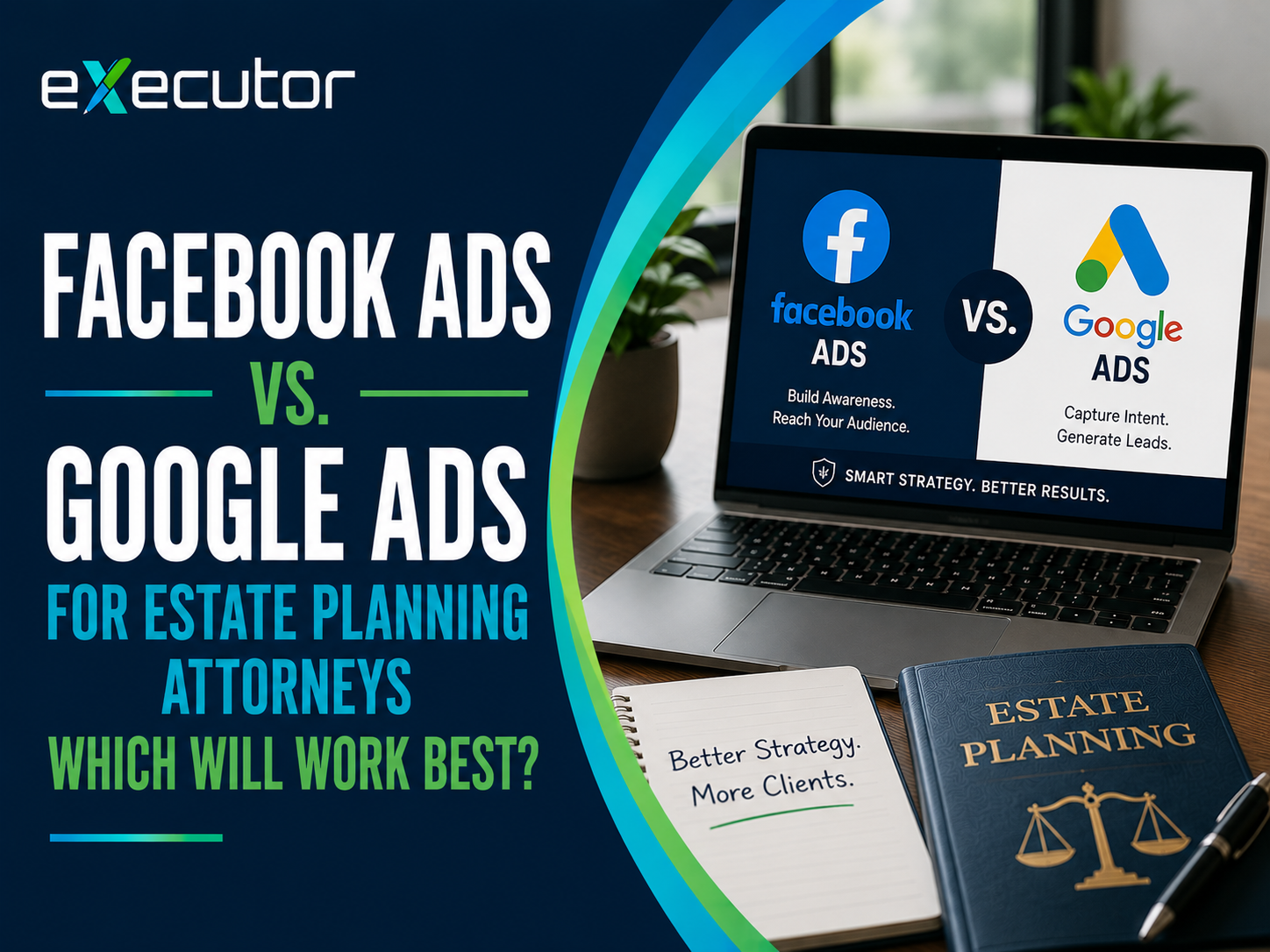
Facebook Ads vs Google Ads for Estate Planning Attorneys: Which Will Work Best
Choosing the right digital advertising platform depends on several factors. Both Facebook (Meta) Ads and Google Ads offer viable solutions, but they differ in how they attract leads and how much they cost to do so. Below is a breakdown of the pros and cons of each platform. I am using a $ 1,000-per-month budget for both. The results may differ based on the competition and audience demographics in your area.
Google Ads: Capturing Intent
Google Ads (Search and Display Networks) is fundamentally an intent-based marketing platform. When someone searches for “draft a will near me” or “estate tax planning attorney,” they are actively looking for the service you provide.
Pros of Google Ads: Google’s strength lies in high-intent traffic; users are actively searching for legal services, which results in higher-quality leads closer to a hiring decision. This platform is perfect for capturing Speed and Urgency related to time-sensitive needs. Another benefit is that you can choose search terms that are specific to the services you provide. You can easily select which geographic location you want to advertise in. For example, in a large city, only specific zip codes would give the right demographics for your firm.
Cons of Google Ads and the $1,000 Budget Impact: The main drawback is the Higher Cost-Per-Click (CPC). There is plenty of competition for high-value estate planning keywords such as “trust attorney,” and “will preparation”. With a $1,000 monthly budget, high CPCs can quickly deplete it—perhaps in just a few days if bidding on premium terms—resulting in very few clicks and limited visibility. There is also a restricted audience since you only capture existing demand, making it difficult to reach people who haven’t yet realized their need. Keep in mind that Google Ads is a search-based advertising platform. If someone isn’t actively looking for estate planning, your ads will not appear.
Facebook (Meta) Ads: Generating Awareness and Demand
Facebook Ads (including Instagram) is a platform based on demographics and interests. Users scroll for entertainment, not to search for an attorney. This platform excels at placing your message in front of a specific profile before they start searching.
Pros of Facebook Ads and the $1,000 Budget Impact: A significant advantage of Facebook and Instagram is that the cost per lead is much less than Google Ads. With a $1,000 budget, you will achieve greater reach and higher volumes of impressions and clicks than on Google Search, allowing you to sustain your campaign for the entire month. Another advantage is that Facebook offers demographic targeting, which is excellent for reaching people based on life stages (e.g., nearing retirement) who need estate planning but aren’t yet searching. Facebook and Instagram are visual media. This means your ads can use graphics and video, and text to tell a story, which can have a greater impact on your intended audience. Google Ads has character limits, as does Facebook, but Facebook’s are much higher. You can also reach a much larger audience, as both platforms have large user bases.
Cons of Facebook Ads: The trade-off for lower costs is lower intent traffic. Leads generated are passive and require significantly more nurturing and follow-up. Going back to the ability to create visual images for your ad, you risk having the graphic or video not appeal to your intended audience. There is also a slower conversion rate as Facebook and Instagram could attract more “tire kickers.”
Which is Best for Estate Planning Attorneys?
If you are looking for people who are actively searching for estate planning attorneys, use Google Ads (Search) to capture high-intent clients who need help today. These people are more likely to convert quickly but are more expensive to acquire.
If you are trying to be cost-conscious and have the patience to nurture leads as they come in, use Facebook Ads. Facebook Ads is where your $1,000 budget provides maximum reach. The downside is that these people are more likely to take their time in deciding, as they didn’t think about your service until they saw your ad.
For estate planning attorneys, the optimal strategy often involves using both platforms in a coordinated manner, but the $1,000 budget forces prioritization. If that is not an option, both platforms will produce results. The question for you is, which nurturing strategy are you most comfortable with: a short nurturing period, Google Ads, or a long nurturing period, Facebook and Instagram ads?